

Plutonium - 94Pu: the essentials
- Name: plutonium
- Symbol: Pu
- Atomic number: 94
- Relative atomic mass (Ar): [ 244 ] (longest lived isotope)
- Standard state: solid at 298 K
- Appearance: silvery white
- Classification: Metallic
- Group in periodic table:
- Group name: Actinoid
- Period in periodic table: 7 (actinoid)
- Block in periodic table: f
- Shell structure: 2.8.18.32.24.8.2
- CAS Registry: 7440-07-5
Plutonium atoms have 94 electrons and the shell structure is 2.8.18.32.24.8.2. The ground state electronic configuration of neutral plutonium is [Rn].5f6.7s2 and the term symbol of plutonium is 7F0.
Plutonium: description
Plutonium was the second transuranium element of the actinide series to be discovered. By far of greatest importance is the isotope 239Pu, which has a half-life of more than 20000 years. One kilogram is equivalent to about 22 million kilowatt hours of heat energy. The complete detonation of a kilogram of plutonium produces an explosion equal to about 20000 tons of chemical explosive. The various nuclear applications of plutonium are well known. The isotope 233Pu was used in the American Apollo lunar missions to power seismic and other equipment on the lunar surface. Plutonium contamination is an emotive environmental problem.

Plutonium dioxide, PuO2. Image adapted with permission from Prof James Marshall's (U. North Texas, USA) Walking Tour of the elements CD.
Plutonium: physical properties
 Density of solid: 19816 kg m-3
 Molar volume: 12.29 cm3
 Thermal conductivity: 6 W m‑1 K‑1
Plutonium: heat properties
 Melting point: 912.5 [639.4 °C (1182.9 °F)] K
 Boiling point: 3503 [3230 °C (5846 °F)] K
 Enthalpy of fusion: 20.5 kJ mol-1
Plutonium: atom sizes
 Atomic radius (empirical): 175 pm
 Molecular single bond covalent radius: 172 (coordination number 3) ppm
 van der Waals radius: (no data) ppm
Plutonium: electronegativities
 Pauling electronegativity: 1.28 (Pauling units)
 Allred Rochow electronegativity: 1.22 (Pauling units)
 Mulliken-Jaffe electronegativity: (no data)
Plutonium: orbital properties
 First ionisation energy: 581.40 kJ mol‑1
 Second ionisation energy: 1110 kJ mol‑1
 Third ionisation energy: 2040 kJ mol‑1
Plutonium: abundances
 Universe: (no data) ppb by weight
 Crustal rocks: (no data) ppb by weight
 Human: (no data) ppb by weight
Plutonium: crystal structure
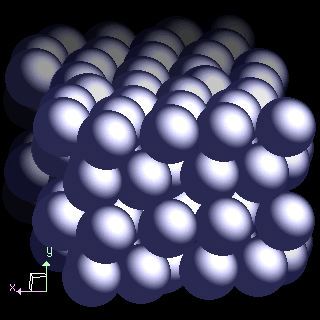
Plutonium: biological data
- Human abundance by weight: (no data) ppb by weight
Plutonium has no biological role.
Plutonium: uses
Plutonium: reactions
Reactions of plutonium as the element with air, water, halogens, acids, and bases where known.
Plutonium: binary compounds
Binary compounds with halogens (known as halides), oxygen (known as oxides), hydrogen (known as hydrides), and other compounds of plutonium where known.
Plutonium: compound properties
Bond strengths; lattice energies of plutonium halides, hydrides, oxides (where known); and reduction potentials where known.
Plutonium: history
Plutonium was discovered by Glenn T. Seaborg , J. W. Kennedy, E. M. McMillan, A. C. Wahl in 1940 at USA. Origin of name: named after "the planet Pluto".Plutonium: isotopes
Plutonium: isolation
Isolation: coming soon!