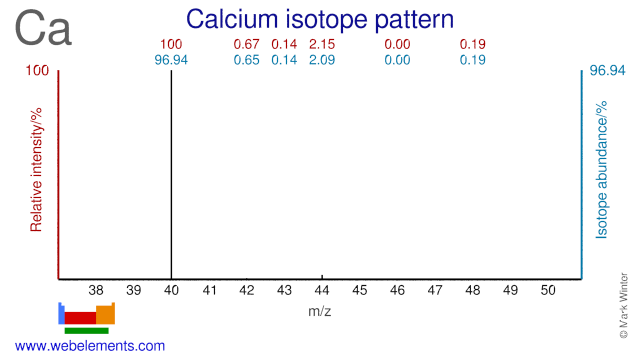
Calcium isotopes (mainly Ca-42, Ca-44, Ca-46 and Ca-48) are used extensively in clinical research and mainly in nutritional studies. They are used to measure calcium absorption mainly in women and children. In adults, calcium deficiency is strongly related to increasing severity of osteoporosis. In children, calcium deficiency is primarily related to the development of rickets. Ca-48 has been used to bombard Pb and Bi targets in order to create super heavy elements.
Isotope abundances of calcium. In the above, the most intense ion is set to 100% since this corresponds best to the output from a mass spectrometer. This is not to be confused with the relative percentage isotope abundances which totals 100% for all the naturally occurring isotopes.
Naturally occurring isotope abundances: Commission on Atomic Weights and Isotopic Abundances report for the International Union of Pure and Applied Chemistry in Isotopic Compositions of the Elements 1989, Pure and Applied Chemistry, 1998, 70, 217. [Copyright 1998 IUPAC]
For further information about radioisotopes see Jonghwa Chang's (Korea Atomic Energy Research Institute) Table of the Nuclides
Masses, nuclear spins, and magnetic moments: I. Mills, T. Cvitas, K. Homann, N. Kallay, and K. Kuchitsu in Quantities, Units and Symbols in Physical Chemistry, Blackwell Scientific Publications, Oxford, UK, 1988. [Copyright 1988 IUPAC]
R.K. Harris in Encyclopedia of Nuclear Magnetic Resonance, D.M. Granty and R.K. Harris, (eds.), vol. 5, John Wiley & Sons, Chichester, UK, 1996. I am grateful to Professor Robin Harris (University of Durham, UK) who provided much of the NMR data, which are copyright 1996 IUPAC, adapted from his contribution contained within this reference.
J. Mason in Multinuclear NMR, Plenum Press, New York, USA, 1987. Where given, data for certain radioactive nuclei are from this reference.
P. Pyykkö, Mol. Phys., 2008, 106, 1965-1974.
P. Pyykkö, Mol. Phys., 2001, 99, 1617-1629.
P. Pyykkö, Z. Naturforsch., 1992, 47a, 189. I am grateful to Professor Pekka Pyykkö (University of Helsinki, Finland) who provided the nuclear quadrupole moment data in this and the following two references.