

Ruthenium - 44Ru: the essentials
- Name: ruthenium
- Symbol: Ru
- Atomic number: 44
- Relative atomic mass (Ar): 101.07 (2) g [see note g]
- Standard state: solid at 298 K
- Appearance: silvery white metallic
- Classification: Metallic
- Group in periodic table: 8
- Group name: Precious metal or Platinum group metal
- Period in periodic table: 5
- Block in periodic table: d
- Shell structure: 2.8.18.15.1
- CAS Registry: 7440-18-8
Ruthenium atoms have 44 electrons and the shell structure is 2.8.18.15.1. The ground state electronic configuration of neutral ruthenium is [Kr].4d75s1 and the term symbol of ruthenium is 5F5.
Ruthenium: description
Ruthenium is a hard, white metal. It does not tarnish at room temperatures, but oxidises in air at about 800°C. The metal is not attacked by hot or cold acids or aqua regia, but when potassium chlorate is added to the solution, it oxidises explosively.
Ruthenium, rhodium, palladium, osmium, iridium, and platinum together make up a group of elements referred to as the platinum group metals (PGM).
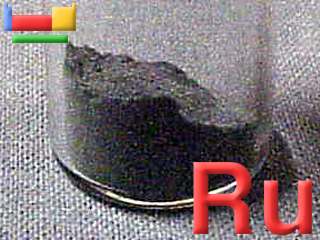
Image adapted with permission from Prof James Marshall's (U. North Texas, USA) Walking Tour of the elements CD.
Ruthenium: physical properties
 Density of solid: 12370 kg m-3
 Molar volume: 8.17 cm3
 Thermal conductivity: 120 W m‑1 K‑1
Ruthenium: heat properties
 Melting point: 2607 [2334 °C (4233 °F)] K
 Boiling point: 4423 [4150 °C (7502 °F)] K
 Enthalpy of fusion: 20.5 kJ mol-1
Ruthenium: atom sizes
 Atomic radius (empirical): 130 pm
 Molecular single bond covalent radius: 125 (coordination number 4) ppm
 van der Waals radius: 246 ppm
Ruthenium: electronegativities
 Pauling electronegativity: 2.2 (Pauling units)
 Allred Rochow electronegativity: 1.42 (Pauling units)
 Mulliken-Jaffe electronegativity: (no data)
Ruthenium: orbital properties
 First ionisation energy: 710.18 kJ mol‑1
 Second ionisation energy: 1617 kJ mol‑1
 Third ionisation energy: 2747 kJ mol‑1
Ruthenium: abundances
 Universe: 4 ppb by weight
 Crustal rocks: 1.0 ppb by weight
 Human: (no data) ppb by weight
Ruthenium: crystal structure

Ruthenium: biological data
- Human abundance by weight: (no data) ppb by weight
Ruthenium has no biological role.
Ruthenium: uses
Ruthenium: reactions
Reactions of ruthenium as the element with air, water, halogens, acids, and bases where known.
Ruthenium: binary compounds
Binary compounds with halogens (known as halides), oxygen (known as oxides), hydrogen (known as hydrides), and other compounds of ruthenium where known.
Ruthenium: compound properties
Bond strengths; lattice energies of ruthenium halides, hydrides, oxides (where known); and reduction potentials where known.
Ruthenium: history
Ruthenium was discovered by Karl Karlovich Klaus in 1844 at Russia. Origin of name: from the Latin word "Ruthenia" meaning "Russia".Ruthenium: isotopes

Ruthenium isotopes are used in several scientific and medical applications. Ru-99 is used for NMR studies. Ru-96 is used for the production of the radioisotopes Ru-94 and Ru-95. Ru-98 has been used to study excitations in atomic nuclei. Ru-100 has been used in isomeric cross section studies. Ru-101 has been used in studies related to the structure and vibrations of nuclei. Ru-102 has been used as a target for the production of the radioisotope Te-116. Ru-104 is used for the production of the radioisotope Rh-105 which has been suggested for the treatment of bone pain.
Ruthenium: isolation
Isolation: it would not normally be necessary to make a sample of ruthenium in the laboratory as the metal is available, at a price, commercially. The industrial extraction of ruthenium is complex as the metal occurs in ores mixed with other metals such as rhodium, palladium, silver, platinum, and gold. Sometimes extraction of the precious metals such as iridium, rhodium, platinum and palladium is the main focus of a partiular industrial operation while in other cases it is a byproduct. The extraction is complex because of the other metals present and only worthwhile since ruthenium is useful as a specialist metal and is the basis of some catalysts in industry.
Preliminary treatment of the ore or base metal byproduct is required to remove silver, gold, palladium, and platinum. The residue is melted with sodium bisulphate (NaHSO4) and the resulting mixture extracted with water to give a solution containing rhodium sulphate, Rh2(SO4)3. The insoluble residue contains the ruthenium. The residue is melted with Na2O2 and extracted into water to extract the ruthenium and osmium salts (including [RuO4]2- and [OsO4(OH)2]2-). The residue contains iridium oxide, IrO2. Reaction of the salt with chlorine gas gives the volatile oxides RuO4 and OsO4. The ruthenium oxide is dissolved by treatment with hydrochloric acid to form H3RuCl6, and the ruthenium precipiated out as pure (NH4)3RuCl6 by treatment with NH4Cl. Evaporation to dryness and burning under hydrogen gas gives pure ruthenium.