

Radon - 86Rn: the essentials
- Name: radon
- Symbol: Rn
- Atomic number: 86
- Relative atomic mass (Ar): [ 222 ] (longest lived isotope)
- Standard state: gas at 298 K (the heaviest known mononuclear gas at 298 K)
- Appearance: colourless
- Classification: Non-metallic
- Group in periodic table: 18
- Group name: Noble gas
- Period in periodic table: 6
- Block in periodic table: p
- Shell structure: 2.8.18.32.18.8
- CAS Registry: 10043-92-2
Radon atoms have 86 electrons and the shell structure is 2.8.18.32.18.8. The ground state electronic configuration of neutral radon is [Xe].4f14.5d10.6s2.6p6 and the term symbol of radon is 1S0.
Radon: description
At ordinary temperatures radon is a colourless gas. When cooled below the freezing point, radon exhibits a brilliant phosphorescence which becomes yellow as the temperature is lowered and orange-red at the temperature of liquid air. The main hazard is from inhalation of the element and its decay products which are collected on dust in the air. Recently, radon buildup in homes from the surrounding soil and rocks has become a safety issue and some areas around the world test homes for radon gas. It is the heaviest known gas. Radon is present in some spring waters.
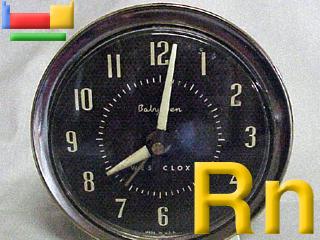
Radon is a decay product of the radium salts used in the luminous paint of the numerals. In this 1950's clock, the glass casing has accumulated 10-16 gram) of radon. Image adapted with permission from Prof James Marshall's (U. North Texas, USA) Walking Tour of the elements CD.
Radon: physical properties
 Density of solid: 4400 kg m-3
 Molar volume: 50.50 cm3
 Thermal conductivity: 0.00361 W m‑1 K‑1
Radon: heat properties
 Melting point: 202 [‑71 °C (‑96 °F)] K
 Boiling point: 211.3 [‑61.7 °C (‑79.1 °F)] K
 Enthalpy of fusion: 20.5 kJ mol-1
Radon: atom sizes
 Atomic radius (empirical): (no data) pm
 Molecular single bond covalent radius: 142 (coordination number 1,2) ppm
 van der Waals radius: 271 ppm
Radon: electronegativities
 Pauling electronegativity: (no data) (Pauling units)
 Allred Rochow electronegativity: (no data) (Pauling units)
 Mulliken-Jaffe electronegativity: 2.59 (12.5% s orbital)
Radon: orbital properties
 First ionisation energy: 1037.07 kJ mol‑1
 Second ionisation energy: 2060 kJ mol‑1
 Third ionisation energy: 2840 kJ mol‑1
Radon: abundances
 Universe: (no data) ppb by weight
 Crustal rocks: (no data) ppb by weight
 Human: (no data) ppb by weight

Radon: biological data
- Human abundance by weight: (no data) ppb by weight
Radon has no biological role.
Radon: uses
Radon: reactions
Reactions of radon as the element with air, water, halogens, acids, and bases where known.
Radon: binary compounds
Binary compounds with halogens (known as halides), oxygen (known as oxides), hydrogen (known as hydrides), and other compounds of radon where known.
Radon: compound properties
Bond strengths; lattice energies of radon halides, hydrides, oxides (where known); and reduction potentials where known.
Radon: history
Radon was discovered by Friedrich Ernst Dorn in 1900 at Germany. Origin of name: named after "the element radium" (radon was called niton at first, from the Latin word "nitens" meaning "shining".Radon: isotopes
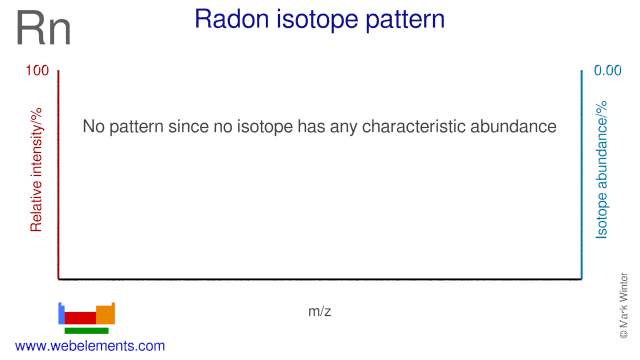
Radon: isolation
Isolation: radon is present to a very small trace extent in the atmosphere and in principle could be obtained as a byproduct from the liquefaction and separation of air. However as only small quantities are ever needed in practice, and because of its short half life (the longest life isotope has a half life of less than 4 days), such quantities as are required are isolated through collection from the radioactive decay of an isotope of radium (226Ra, half life 1599 years).
226Ra → 222Rn + 4He
This method gives 0.64 cm3 of radon gas per gram of radium per month.