

Rhodium - 45Rh: the essentials
- Name: rhodium
- Symbol: Rh
- Atomic number: 45
- Relative atomic mass (Ar): 102.90550 (2)
- Standard state: solid at 298 K
- Appearance: silvery white metallic
- Classification: Metallic
- Group in periodic table: 9
- Group name: Precious metal or Platinum group metal
- Period in periodic table: 5
- Block in periodic table: d
- Shell structure: 2.8.18.16.1
- CAS Registry: 7440-16-6
Rhodium atoms have 45 electrons and the shell structure is 2.8.18.16.1. The ground state electronic configuration of neutral rhodium is [Kr].4d85s1 and the term symbol of rhodium is 4F9/2.
Rhodium: description
Rhodium metal is silvery white. Rhodium has a higher melting point and lower density than platinum. It has a high reflectance and is hard and durable. Upon heating it turns to the oxide when red and at higher temperatures turns back to the element. It is a major component of industrial catalytic systems such as the BP-Monsanto process.
Ruthenium, rhodium, palladium, osmium, iridium, and platinum together make up a group of elements referred to as the platinum group metals (PGM).

Rhodium wire.
Rhodium: physical properties
 Density of solid: 12450 kg m-3
 Molar volume: 8.28 cm3
 Thermal conductivity: 150 W m‑1 K‑1
Rhodium: heat properties
 Melting point: 2237 [1964 °C (3567 °F)] K
 Boiling point: 3968 [3695 °C (6683 °F)] K
 Enthalpy of fusion: 20.5 kJ mol-1
Rhodium: atom sizes
 Atomic radius (empirical): 135 pm
 Molecular single bond covalent radius: 125 (coordination number 4) ppm
 van der Waals radius: 244 ppm
Rhodium: electronegativities
 Pauling electronegativity: 2.28 (Pauling units)
 Allred Rochow electronegativity: 1.45 (Pauling units)
 Mulliken-Jaffe electronegativity: (no data)
Rhodium: orbital properties
 First ionisation energy: 719.67 kJ mol‑1
 Second ionisation energy: 1744 kJ mol‑1
 Third ionisation energy: 2997 kJ mol‑1
Rhodium: abundances
 Universe: 0.6 ppb by weight
 Crustal rocks: 0.70 ppb by weight
 Human: (no data) ppb by weight
Rhodium: crystal structure
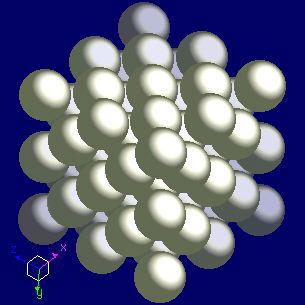
Rhodium: biological data
- Human abundance by weight: (no data) ppb by weight
Rhodium has no biological role.
Rhodium: uses
Rhodium: reactions
Reactions of rhodium as the element with air, water, halogens, acids, and bases where known.
Rhodium: binary compounds
Binary compounds with halogens (known as halides), oxygen (known as oxides), hydrogen (known as hydrides), and other compounds of rhodium where known.
Rhodium: compound properties
Bond strengths; lattice energies of rhodium halides, hydrides, oxides (where known); and reduction potentials where known.
Rhodium: history
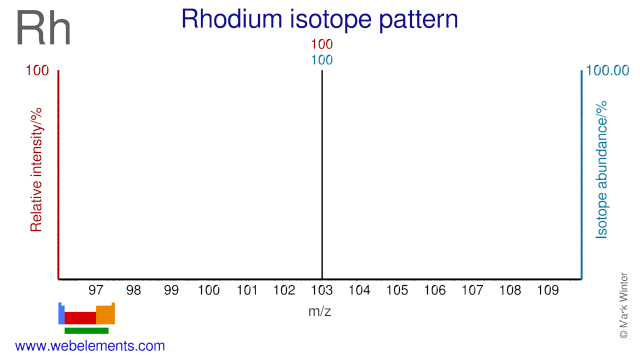
Rhodium was discovered by William Hyde Wollaston in 1803 at England. Origin of name: from the Greek word "rhodon" meaning "rose".Rhodium: isotopes
Rhodium: isolation
Isolation: it would not normally be necessary to make a sample of rhodium in the laboratory as the metal is available, at a price, commercially. The industrial extraction of rhodium is complex as the metal occurs in ores mixed with other metals such as palladium, silver, platinum, and gold. Sometimes extraction of the precious metals such as rhodium, platinum and palladium is the main focus of a partiular industrial operation while in other cases it is a byproduct. The extraction is complex because of the other metals present and only worthwhile since rhodium is the basis of very important catalysts in industry.
Preliminary treatment of the ore or base metal byproduct is required to remove silver, gold, palladium, and platinum. The resulting residue is melted with sodium bisulphate (NaHSO4) and the resulting mixture extracted water to give a solution containing rhodium sulphate, Rh2(SO4)3. The rhodium is precipitated out as the hydroxide by addition of sodium hydroxide, NaOH, and redissolved in hydrochloric acid, HCl, to give H3RhCl6. This is treated with NaNO2 and NH4Cl to form a precipitate of the rhodium complex (NH4)3[Rh(NO2)6]. Dissolution of the precipitate in HCl gives a solution of pure (NH4)3RhCl6. Evaporation to dryness and burning under hydrogen gas gives pure rhodium.