
Rubidium - 37Rb: the essentials
- Name: rubidium
- Symbol: Rb
- Atomic number: 37
- Relative atomic mass (Ar): 85.4678 (3) g [see note g]
- Standard state: solid at 298 K
- Appearance: silvery white
- Classification: Metallic
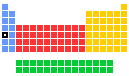
- Group in periodic table: 1
- Group name: Alkali metal
- Period in periodic table: 5
- Block in periodic table: s
- Shell structure: 2.8.18.8.1
- CAS Registry: 7440-17-7
Rubidium atoms have 37 electrons and the shell structure is 2.8.18.8.1. The ground state electronic configuration of neutral rubidium is [Kr].5s1 and the term symbol of rubidium is 2S1/2.
Rubidium: description
Rubidium can be liquid at ambient temperature, but only on a hot day given that its melting point is about 40°C. It is a soft, silvery-white metallic element of the alkali metals group (Group 1). It is one of the most most electropositive and alkaline elements. It ignites spontaneously in air and reacts violently with water, setting fire to the liberated hydrogen. As so with all the other alkali metals, it forms amalgams with mercury. It alloys with gold, caesium, sodium, and potassium. It colours a flame yellowish-violet.
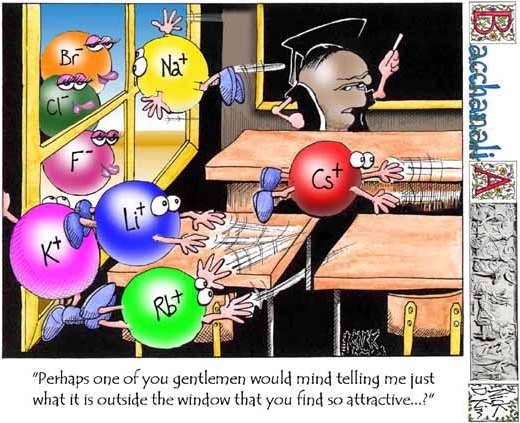
Cartoon by Nick D Kim ([Science and Ink], used by permission).
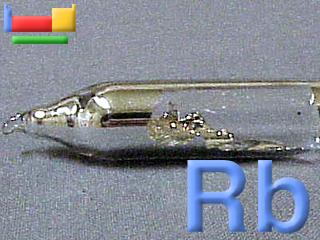
Image adapted with permission from Prof James Marshall's (U. North Texas, USA) Walking Tour of the elements CD.
Rubidium: physical properties
 Density of solid: 1532 kg m-3
 Molar volume: 55.76 cm3
 Thermal conductivity: 58 W m‑1 K‑1
Rubidium: heat properties
 Melting point: 312.46 [39.31 °C (102.76 °F)] K
 Boiling point: 961 [688 °C (1270 °F)] K
 Enthalpy of fusion: 20.5 kJ mol-1
Rubidium: atom sizes
 Atomic radius (empirical): 235 pm
 Molecular single bond covalent radius: 210 (coordination number 1) ppm
 van der Waals radius: 321 ppm
Rubidium: electronegativities
 Pauling electronegativity: 0.82 (Pauling units)
 Allred Rochow electronegativity: 0.89 (Pauling units)
 Mulliken-Jaffe electronegativity: 0.69 (s orbital)
Rubidium: orbital properties
 First ionisation energy: 403.03 kJ mol‑1
 Second ionisation energy: 2633.04 kJ mol‑1
 Third ionisation energy: 3786.8 kJ mol‑1
Rubidium: abundances
 Universe: 10 ppb by weight
 Crustal rocks: 60000 ppb by weight
 Human: 4600 ppb by weight
Rubidium: crystal structure
Rubidium: biological data
- Human abundance by weight: 4600 ppb by weight
Rubidium has no biological role but is said to stimulate the metabolism. It can accumulate ahead of potassium in muscle.
Rubidium: uses
Rubidium: reactions
Reactions of rubidium as the element with air, water, halogens, acids, and bases where known.
Rubidium: binary compounds
Binary compounds with halogens (known as halides), oxygen (known as oxides), hydrogen (known as hydrides), and other compounds of rubidium where known.
Rubidium: compound properties
Bond strengths; lattice energies of rubidium halides, hydrides, oxides (where known); and reduction potentials where known.
Rubidium: history
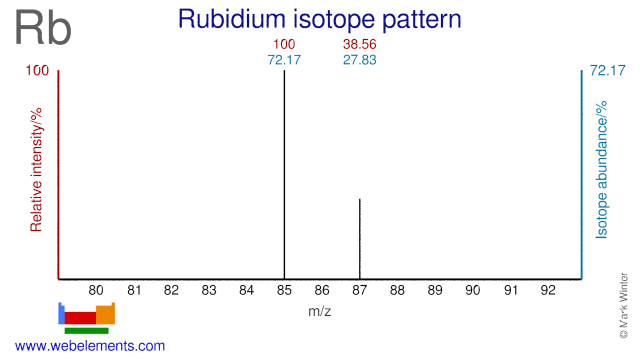
Rubidium was discovered by Robert Bunsen, Gustav Kirchhoff in 1861 at Germany. Origin of name: from the Latin word "rubidius" meaning "dark red" or "deepest red".Rubidium: isotopes
Rubidium: isolation
Isolation: rubidium would not normally be made in the laboratory as it is available commercially. All syntheses require an electrolytic step as it is so difficult to add an electron to the poorly electronegative rubidium ion Rb+.
Rubidium is not made by the same method as sodium as might have been expected. This is because the rubidium metal, once formed by electrolysis of liquid rubidium chloride (RbCl), is too soluble in the molten salt.
cathode: Rb+(l) + e- → Rb (l)
anode: Cl-(l) → 1/2Cl2 (g) + e-
Instead, it is made by the reaction of metallic sodium with hot molten rubidium chloride.
Na + RbCl ⇌ Rb + NaCl
This is an equilibrium reaction and under these conditions the rubidium is highly volatile and removed from the system in a form relatively free from sodium impurities, allowing the reaction to proceed.