

Sodium - 11Na: the essentials
- Name: sodium
- Symbol: Na
- Atomic number: 11
- Relative atomic mass (Ar): 22.98976928 (2)
- Standard state: solid at 298 K
- Appearance: silvery white
- Classification: Metallic
- Group in periodic table: 1
- Group name: Alkali metal
- Period in periodic table: 3
- Block in periodic table: s
- Shell structure: 2.8.1
- CAS Registry: 7440-23-5
Sodium atoms have 11 electrons and the shell structure is 2.8.1. The ground state electronic configuration of neutral sodium is [Ne].3s1 and the term symbol of sodium is 2S1/2.
Sodium: description
Sodium is a Group 1 element (or IA in older labelling styles). Group 1 elements are often referred to as the "alkali metals". The chemistry of sodium is dominated by the +1 ion Na+. Sodium salts impart a characteristic orange/yellow colour to flames and orange street lighting is orange because of the presence of sodium in the lamp.
Soap is generally a sodium salt of fatty acids. The importance of common salt to animal nutrition has been recognized since prehistoric times. The most common compound is sodium chloride, (table salt).
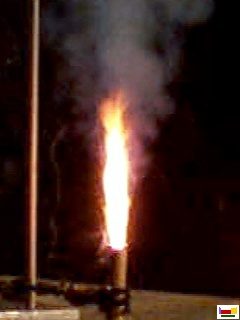
The picture above shows the colour arising from adding common salt (NaCl) to a burning mixture of potassium chlorate and sucrose.
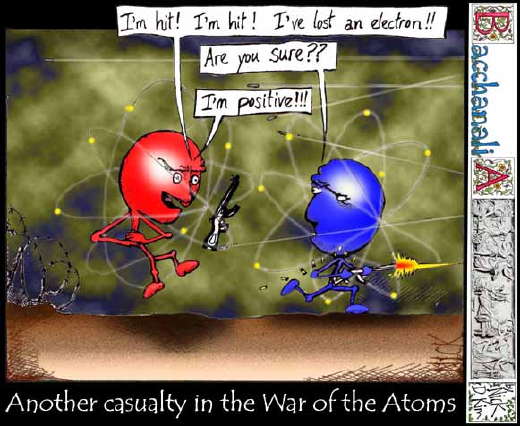
The chemistry of sodium is dominated by electron loss to form Na+. Cartoon by Nick D Kim ([Science and Ink], used by permission).
Sodium: physical properties
 Density of solid: 968 kg m-3
 Molar volume: 23.78 cm3
 Thermal conductivity: 140 W m‑1 K‑1
Sodium: heat properties
 Melting point: 370.87 [97.72 °C (207.9 °F)] K
 Boiling point: 1156 [883 °C (1621 °F)] K
 Enthalpy of fusion: 20.5 kJ mol-1
Sodium: atom sizes
 Atomic radius (empirical): 180 pm
 Molecular single bond covalent radius: 155 (coordination number 1) ppm
 van der Waals radius: 250 ppm
Sodium: electronegativities
 Pauling electronegativity: 0.93 (Pauling units)
 Allred Rochow electronegativity: 1.01 (Pauling units)
 Mulliken-Jaffe electronegativity: 0.91 (s orbital)
Sodium: orbital properties
 First ionisation energy: 495.85 kJ mol‑1
 Second ionisation energy: 4562.44 kJ mol‑1
 Third ionisation energy: 6910.28 kJ mol‑1
Sodium: abundances
 Universe: 20000 ppb by weight
 Crustal rocks: 23000000 ppb by weight
 Human: 1400000 ppb by weight
Sodium: crystal structure

Sodium: biological data
- Human abundance by weight: 1400000 ppb by weight
Sodium is a vital element. The human diet must contain a sensible amount of sodium. The sodium cation is the main extracellular (outside cells) cation in animals and is important for nerve function in animals.
The importance of sodium as salt in the diet was recognized well before sodium itself was understood to be an element. This recognition formed the basis of trading of salt deposits lining the Dead Sea in biblical times by the Romans. Prolonged sweating results in sodium ion loss in sweat and it is most important that the sodium ion is replaced through proper diet.
Sodium: uses
Sodium: reactions
Reactions of sodium as the element with air, water, halogens, acids, and bases where known.
Sodium: binary compounds
Binary compounds with halogens (known as halides), oxygen (known as oxides), hydrogen (known as hydrides), and other compounds of sodium where known.
Sodium: compound properties
Bond strengths; lattice energies of sodium halides, hydrides, oxides (where known); and reduction potentials where known.
Sodium: history
Sodium was discovered by Sir Humphrey Davy in 1807 at England. Origin of name: from the English word "soda" (the origin of the symbol Na comes from the Latin word "natrium").Sodium: isotopes

Sodium: isolation
Isolation: sodium would not normally be made in the laboratory as it is so readily available commercially. All syntheses require an electrolytic step as it is so difficult to add an electron to the poorly electronegative sodium ion Na+.
Sodium is present as salt (sodium chloride, NaCl) in huge quantities in underground deposits (salt mines) and seawater and other natural waters. It is easily recovered as a solid by drying.
Sodium chloride has a high melting point (> 800°C) meaning that it sould be expensive to melt it in order to carry out the electrolysis. However a mixture of NaCl (40%) and calcium chloride, CaCl2 (60%) melts at about 580°C and so much less energy and so expense is required for the electrolysis.
cathode: Na+(l) + e- → Na (l)
anode: Cl-(l) → 1/2Cl2 (g) + e-
The electrolysis is carried out as a melt in a "Downs cell". In practice, the electrolysis process produces calcium metal as well but this is solidified in a collection pipe and returned back to the melt.