

Astatine - 85At: the essentials
- Name: astatine
- Symbol: At
- Atomic number: 85
- Relative atomic mass (Ar): [ 210 ] (longest lived isotope)
- Standard state: solid at 298 K
- Appearance: metallic
- Classification: Semi-metallic
- Group in periodic table: 17
- Group name: Halogen
- Period in periodic table: 6
- Block in periodic table: p
- Shell structure: 2.8.18.32.18.7
- CAS Registry: 7440-68-8
Astatine atoms have 85 electrons and the shell structure is 2.8.18.32.18.7. The ground state electronic configuration of neutral astatine is [Xe].4f14.5d10.6s2.6p5 and the term symbol of astatine is 2P3/2.
Astatine: description
The longest-lived isotope, 210At, has a half-life of only 8.3 hours. There are about 20 isotopes known, all of which are radioactive. Astatine is a halogen and possibly accumulates in the thyroid like iodine.
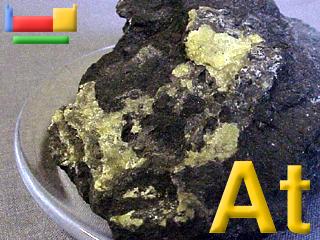
This sample of uranite contains a vanishingly small amount of astatine. Image adapted with permission from Prof James Marshall's (U. North Texas, USA) Walking Tour of the elements CD.
Astatine: physical properties
 Density of solid: 6400 (estimated) kg m-3
 Molar volume: 33 (rough estimate based upon density estimate) cm3
 Thermal conductivity: 1.7 (estimate) W m‑1 K‑1
Astatine: heat properties
 Melting point: 575 [302 °C (576 °F)] K
 Boiling point: 503 [230 °C (446 °F)] K
 Enthalpy of fusion: 20.5 kJ mol-1
Astatine: atom sizes
 Atomic radius (empirical): (no data) pm
 Molecular single bond covalent radius: 147 (coordination number 1) ppm
 van der Waals radius: [ 288 ] ppm
Astatine: electronegativities
 Pauling electronegativity: 2.2 (Pauling units)
 Allred Rochow electronegativity: 1.90 (Pauling units)
 Mulliken-Jaffe electronegativity: 2.85 (14.3% s orbital)
Astatine: orbital properties
 First ionisation energy: 899.00 kJ mol‑1
 Second ionisation energy: 1725 kJ mol‑1
 Third ionisation energy: 2565 kJ mol‑1
Astatine: abundances
 Universe: (no data) ppb by weight
 Crustal rocks: (no data) ppb by weight
 Human: (no data) ppb by weight
Astatine: crystal structure

Astatine: biological data
- Human abundance by weight: (no data) ppb by weight
Astatine has no biological role.
Astatine: uses
Astatine: reactions
Reactions of astatine as the element with air, water, halogens, acids, and bases where known.
Astatine: binary compounds
Binary compounds with halogens (known as halides), oxygen (known as oxides), hydrogen (known as hydrides), and other compounds of astatine where known.
Astatine: compound properties
Bond strengths; lattice energies of astatine halides, hydrides, oxides (where known); and reduction potentials where known.
Astatine: history
Astatine was discovered by Dale Corson, MacKenzie, Segre in 1940 at California, USA. Origin of name: from the Greek word "astatos" meaning "unstable".Astatine: isotopes

Astatine: isolation
Isolation: astatine is radioactive and essentially unavailable in nature. It is not possible to make other than in a nuclear reactor. Bombardment of the bismuth isotope 20983Bi with α-particles (helium nuclei, 42He) results in formation of shortlived astatine and neutrons. The bismuth target is cooled during irradiation to prevent the volatile astatine disappearing.
20983Bi + 42He → 21185At + 2 10n
The 211At isotope has a half life of just over 7 hours so it is necessary to work quickly with it! Available quantities are of the order of 0.001 mg.
Heating the bismuth target to 300-600°C under N2 results in a stream of the elemental astatine that can be collected on a cold glass finger.