
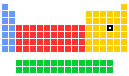
Teteaselenium hexadecabromide
- Formula: [SeBr4]4
- Hill system formula: Br16Se4
- CAS registry number: [7789-65-3]
- Formula weight: 1594.304
- Class: bromide
- Colour: yellow or orange-red
- Appearance: solid
- Melting point: 75°C (decomposes)
- Boiling point: 123°C
- Density: 4030 kg m-3
The following are some synonyms of teteaselenium hexadecabromide :
- teteaselenium hexadecabromide
- selenium(IV) bromide
- selenium bromide
- selenium bromide (alpha form)
- selenium tetrabromide
The oxidation number of selenium in teteaselenium hexadecabromide is 4.
Synthesis
Not available
Solid state structure
- Geometry of selenium:
- Prototypical structure:

Element analysis
The table shows element percentages for [SeBr4]4 (teteaselenium hexadecabromide ).
| Element | % |
|---|---|
| Br | 80.19 |
| Se | 19.81 |
Isotope pattern for [SeBr4]4
The chart below shows the calculated isotope pattern for the formula [SeBr4]4 with the most intense ion set to 100%.
References
The data on these compounds pages are assembled and adapted from the primary literature and several other sources including the following.
- R.T. Sanderson in Chemical Periodicity, Reinhold, New York, USA, 1960.
- N.N. Greenwood and A. Earnshaw in Chemistry of the Elements, 2nd edition, Butterworth, UK, 1997.
- F.A. Cotton, G. Wilkinson, C.A. Murillo, and M. Bochmann, in Advanced Inorganic Chemistry, John Wiley & Sons, 1999.
- A.F. Trotman-Dickenson, (ed.) in Comprehensive Inorganic Chemistry, Pergamon, Oxford, UK, 1973.
- R.W.G. Wyckoff, in Crystal Structures, volume 1, Interscience, John Wiley & Sons, 1963.
- A.R.West in Basic solid state chemistry Chemistry, John Wiley & Sons, 1999.
- A.F. Wells in Structural inorganic chemistry, 4th edition, Oxford, UK, 1975.
- J.D.H. Donnay, (ed.) in Crystal data determinative tables, ACA monograph number 5, American Crystallographic Association, USA, 1963.
- D.R. Lide, (ed.) in Chemical Rubber Company handbook of chemistry and physics, CRC Press, Boca Raton, Florida, USA, 77th edition, 1996.
- J.W. Mellor in A comprehensive treatise on inorganic and theoretical chemistry, volumes 1-16, Longmans, London, UK, 1922-1937.
- J.E. Macintyre (ed.) in Dictionary of inorganic compounds, volumes 1-3, Chapman & Hall, London, UK, 1992.